

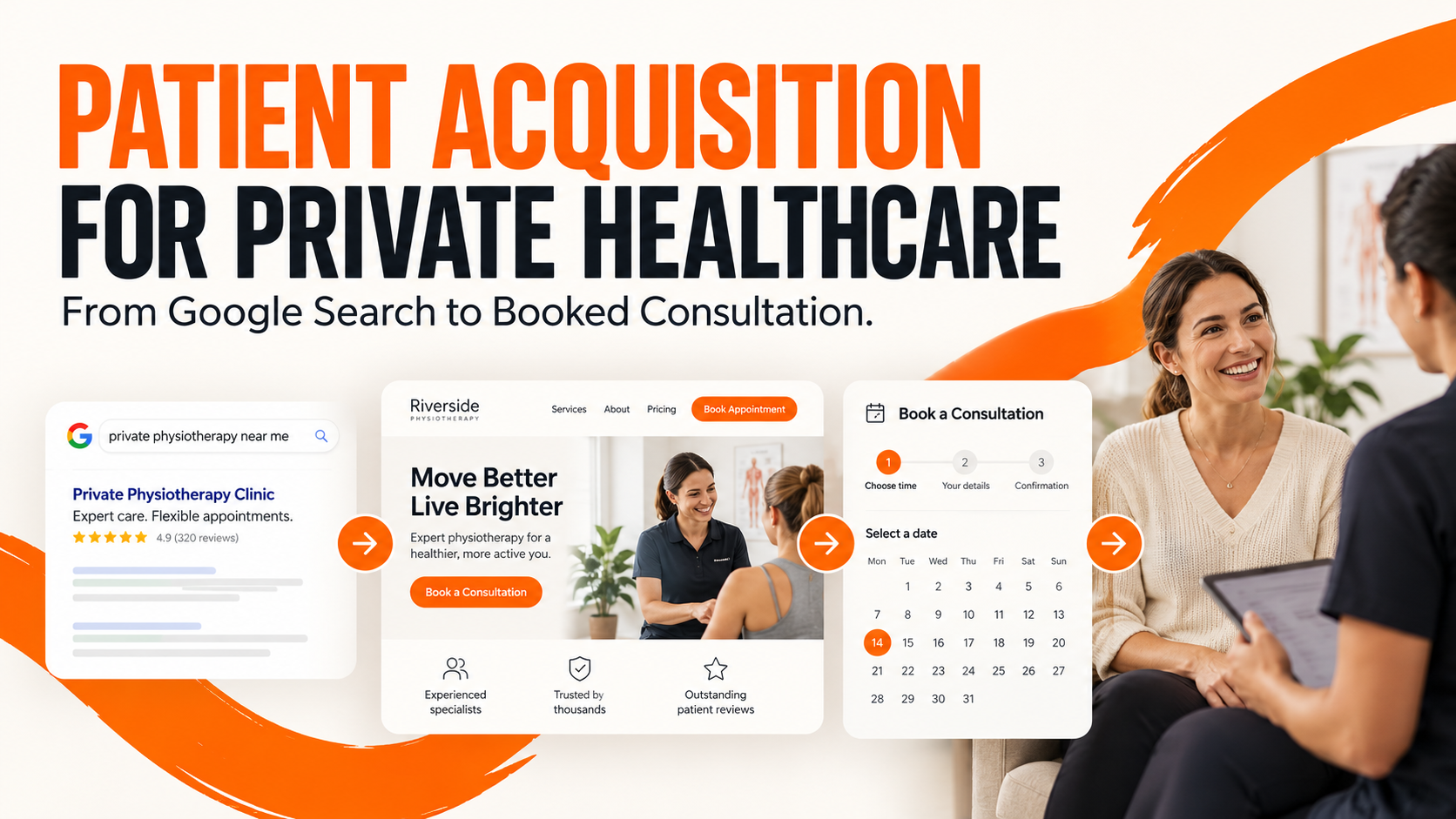
For a private healthcare provider, generating website traffic is not the same as generating new patients.
A potential patient may search Google, compare several clinics, read consultant profiles, check reviews, visit a service page and leave without making contact. Another may find the clinic through a Google Ad, return through an organic search several days later and eventually book by phone.
That is why patient acquisition for private healthcare should be treated as a complete journey, not a collection of separate marketing activities.
SEO, Google Ads, local search, content, website design and enquiry tracking should work together to move the right prospective patients from their initial search towards a booked consultation.
What Is Patient Acquisition in Private Healthcare?
Patient acquisition is the process of attracting prospective patients and converting their interest into genuine enquiries and appointments.
For private clinics, this usually begins long before someone contacts reception.
Most people will not book with a private clinic the first time they come across it. They might find the clinic on Google, have a quick look at the website, check a few other options and come back later before deciding whether to get in touch.
Marketing needs to account for that whole process, rather than focusing only on getting someone onto the website.
A clinic could rank well on Google but lose enquiries because its website is difficult to navigate. Another could run successful Google Ads but struggle to understand their return because they aren’t tracking telephone calls.
Effective acquisition connects these different areas rather than measuring each channel in isolation.
Start With the Searches Potential Patients Actually Make
The first step is understanding search intent.
Someone searching for a general health topic may be gathering information and have no immediate intention of booking privately. Someone searching for a specific specialist, service or clinic in their area is usually much further along the decision-making process.
A private clinic’s healthcare SEO strategy should therefore distinguish between informational and commercial searches.
Service pages can target searches closely connected with appointments, while supporting articles can answer earlier questions and introduce prospective patients to the clinic.
Internal links between those pages then provide a natural route towards relevant services, consultant profiles and booking information.
Google continues to recommend useful, original, people-first content rather than material produced primarily to manipulate rankings. Its guidance also places particular emphasis on trust for subjects that can affect health.
For healthcare businesses, that makes clear authorship, accurate information, appropriate clinical review and transparent information about the organisation particularly important.
Local Search Can Be Critical for Private Clinics
Many private healthcare searches have a strong geographical element.
A patient may search for a dermatologist in London, a physiotherapist near their workplace or a private GP within travelling distance of home.
This makes local SEO an important part of patient acquisition.
Google states that local results are mainly influenced by relevance, distance and prominence. Accurate and complete Google Business Profile information helps Google understand a business and match it with relevant local searches.
Clinics should therefore keep their address, contact information, opening hours, website links, categories and other relevant profile information accurate.
The website should reinforce this information with strong clinic-location pages and clear information about the services available at each location.
For multi-location healthcare providers, each clinic should have a useful location page rather than relying on one generic contact page for every branch.
Use Google Ads to Capture High-Intent Demand
SEO can build sustainable visibility, but Google Ads can put a clinic in front of people already searching for specific healthcare services.
A strong Google Ads strategy for private healthcare should focus on intent rather than simply generating clicks.
Campaign structure, keyword selection, geographical targeting, negative keywords and landing-page relevance all influence whether paid traffic produces useful enquiries.
Sending every advertisement to the homepage is rarely the strongest approach. Someone searching for a particular service should generally reach a page dedicated to that service, with the information needed to decide what to do next.
Healthcare advertisers also need to account for Google’s healthcare advertising requirements. Certain healthcare and medicine-related services are restricted or require certification, and Google treats health information as a sensitive category for personalised advertising.
This is one reason specialist healthcare Google Ads management can differ significantly from advertising less regulated services.
Your Website Has to Convert Visibility Into Enquiries
Getting the prospective patient to the website is only half the job.
Once they arrive, the website must answer the questions that influence whether they continue.
Can they quickly understand what the clinic offers? Is it clear where the clinic is based? Can they identify the relevant consultant? Are fees or booking information available where appropriate? Does the organisation appear credible? Is there an obvious next step?
This is where healthcare website optimisation and conversion rate optimisation become part of patient acquisition.
Pages should have clear navigation, readable content and relevant calls to action without becoming aggressive or overly promotional.
On mobile devices in particular, patients should not need to search through several pages simply to find a telephone number, appointment form or booking option.
Build Trust Before Asking for the Booking
Private healthcare involves a significant trust decision.
A prospective patient may compare multiple providers before contacting anyone. The clinic’s online presence therefore needs to answer not only “Do they provide this service?” but also “Why should I feel confident contacting them?”
Useful trust signals may include consultant biographies, professional qualifications, clinic information, genuine patient feedback used appropriately, transparent pricing information where applicable and clear explanations of how appointments work.
Educational content can support this process too.
A strong content strategy demonstrates knowledge before the prospective patient is ready to enquire while creating additional routes into commercially important service pages.
Google’s newer AI-powered Search experiences have not removed the importance of these fundamentals. Google says standard SEO practices remain relevant to AI Overviews and AI Mode, including useful content, internal linking, page experience and keeping Business Profile information current.
Track the Journey From Search to Consultation
One of the biggest patient acquisition mistakes is measuring traffic instead of outcomes.
More website visitors do not necessarily mean more suitable patients.
Private healthcare providers should connect marketing analytics and call tracking with their SEO, advertising and website activity.
Useful measurements include:
- enquiry forms submitted;
- telephone calls generated;
- appointment or booking actions;
- the marketing source behind each enquiry;
- the service or landing page that produced it;
- enquiry quality; and
- where possible, progression from enquiry to booked consultation.
This creates a clearer picture of which marketing activity contributes to practice growth.
A campaign generating fewer enquiries may ultimately be more valuable if those enquiries are consistently relevant and convert into appropriate appointments.
Patient Acquisition Requires a Connected Strategy
The strongest private healthcare marketing strategies don’t treat SEO, Google Ads, local search, content, and website conversion as separate projects.
They connect them.
Search visibility brings the clinic into consideration. Useful content answers questions. Consultant and clinic information builds confidence. Landing pages clarify the next step. Conversion optimisation reduces unnecessary barriers. Tracking then shows which parts of the journey drive real results.
That is the difference between simply generating traffic and building a measurable private healthcare patient acquisition strategy.
For clinics looking to grow, the objective should not be to appear everywhere online. It should be to appear in the right places, for the right searches, provide the information prospective patients need and create a straightforward route from discovery to consultation.


