
Google Ads for Private Clinics
If your clinic needs more enquiries, more calls, and more of the right patients, Google Ads can be one of the fastest and most effective ways to generate demand.
Useful clinic advertising guides: Read our healthcare PPC and intent guide, GP appointment advertising checklist and specialist consultation Google Ads guide. Compare landing-page usability through our clinic website optimisation service and understand real enquiries through call and enquiry tracking.
But for many private clinics, the problem is not whether Google Ads can work. It is whether the account is being managed in a way that actually protects budget, attracts high-intent traffic, and filters out wasted spend.
Too often, private healthcare businesses end up paying for the wrong clicks. Campaigns are allowed to drift. Keywords become too broad. Locations are too loose. Search terms are poorly controlled. Lead quality drops, cost per enquiry rises, and the clinic starts questioning whether paid advertising is worth it at all.
The truth is that Google Ads can work extremely well for private clinics, but only when the strategy is built around intent, control, and commercial reality.
At Spiders & Milk, Google Ads sits alongside healthcare SEO and wider clinic growth strategy as part of a practical, results-focused service for healthcare providers.

Google Ads is powerful because it captures demand at the moment somebody is actively searching.
Unlike social media, where you are often interrupting someone who is not necessarily looking for care, Google Ads allows your clinic to appear when a person is already searching for a solution. That might be a private GP near them, a women’s health appointment, physiotherapy for a sports injury, a travel vaccine clinic, a blood test, or another private healthcare service they want quickly.

Why Google Ads works so well for private clinics
That intent matters.
A person who searches for a service in Google is often much closer to making contact than someone passively scrolling through a social feed. This is why Google Ads can be such a strong channel for clinics that want enquiries with clearer commercial intent.
For private clinics, it also offers something very important: control.
You can decide which services to promote, which areas to target, which hours to show ads, which search terms to exclude, which landing pages to use, and how aggressively to scale. That makes Google Ads especially useful for clinics that need a measurable route to patient acquisition without throwing budget around blindly.
The biggest mistake clinics make with paid search
The biggest mistake is chasing traffic instead of chasing the right traffic.
A campaign can look busy on paper and still perform badly. It might bring in clicks, impressions, and even phone calls, but if those leads are poor quality, outside your location, looking for free NHS care, searching for something you do not offer, or comparing prices with no intent to book, the spend can disappear quickly.
This is where many clinic accounts go wrong.
Broad targeting and weak search term control often create a false sense of progress. The clinic sees activity in the account, but the wrong users are consuming budget. Eventually, the business starts to feel that Google Ads is expensive, when in reality the issue is usually poor strategy and low control.
Google Ads for private clinics should never be built on vanity metrics alone. The real question is not “How many clicks did we get?” It is “Did the budget bring in the right kind of patient enquiry?”
Budget control matters more than budget size
A larger budget does not automatically mean a better outcome.
Many clinics assume that success in Google Ads comes down to spending more. In reality, budget control is often more important than budget level, especially in private healthcare where some clicks can be expensive and some services are far more commercially valuable than other

A well-managed clinic account should protect spend carefully.
That means:
- prioritising the services that actually drive revenue
- separating campaigns by service intent
- avoiding broad keyword waste
- narrowing location settings properly
- controlling ad schedule where needed
- using strong negatives to reduce poor-fit searches
- matching landing pages closely to the user’s intent
A smaller, well-structured budget can outperform a larger, messy account because the money is being directed where it matters most.
For example, a clinic may not need to advertise every service equally. Some services may produce better margins, stronger repeat business, or better patient lifetime value. Others may generate lots of clicks but poor conversion quality. Budget control means making strategic decisions rather than treating all traffic as equal.
High-intent traffic is where the value is
Not all searches are worth paying for.
In private healthcare, the most valuable traffic usually comes from users showing direct service intent. These are the people searching for a specific service, often with a location, urgency, or provider-related cue built into the query.

Examples of higher-intent searches might include:
- Private GP Canary Wharf
- Same-day physio appointment in London
- Private blood test near me
- Travel clinic in London
- Private women’s health clinic
- Sports injury clinic near me
These users are often much closer to taking action than someone typing a very broad educational query.
That does not mean top-of-funnel searches are useless. They can still have value. But if a private clinic is trying to drive enquiries efficiently, especially with a finite budget, the campaign structure should lean towards high-intent search behaviour first.
This is one reason Google Ads can outperform broader awareness channels for clinics. It allows you to pay for visible demand rather than hoping to create it from scratch.
Local targeting is essential for private clinics
Most private clinics do not need nationwide traffic.
Even if your clinic has a strong reputation, the bulk of your most commercially relevant traffic is usually local or regionally targeted. Patients often want convenience, accessibility, and a provider they can actually reach without friction.
That is why local targeting should be one of the foundations of a private clinic Google Ads account.

Good local targeting is not just about selecting a city and leaving it there. It often involves:
- Targeting the right radius or boroughs
- Excluding areas that rarely convert
- Aligning campaigns with service catchment
- Matching ad copy to local intent
- Using landing pages that reinforce location relevance
- Monitoring which areas drive real enquiries, not just clicks
This matters because badly set location targeting can drain budget fast. A clinic may think it is advertising to nearby patients while the account is quietly picking up traffic from outside the real service area.
For clinics with one physical site, geographic discipline is critical. For clinics with multiple locations, the campaign structure usually needs to reflect each catchment separately rather than pooling everything together.
Lead quality matters more than lead volume.
More leads is not always better.
If the phone rings constantly but most callers are not suitable, cannot afford private care, are outside your area, want a service you do not provide, or were expecting an NHS route, then the campaign is creating operational noise rather than commercial value.
This is especially relevant in healthcare.
Reception teams are busy. Clinicians are busy. Practice managers do not need inflated lead numbers if those leads waste time and distract from genuine opportunities. Private clinic advertising should aim for better-fit enquiries, not just more of them.
Lead quality improves when the account is designed to pre-qualify traffic before the click.Lead quality improves when the account is designed to pre-qualify traffic before the click.
That includes:
- Tighter keyword intent
- More precise ad copy
- Stronger service matching
- Better landing page messaging
- Clearer signals about who the service is for
- Clearer pricing or a private-care context where appropriate
- Exclusion of poor-fit search terms
- The aim is to reduce friction after the click by filtering harder before the click.

Where wasted spend usually comes from
Wasted spend in the clinic Google Ads is usually very predictable.
It tends to come from a few common issues.
Broad match without enough control
Broad traffic can open the door to irrelevant searches if the account is not monitored properly. This is especially risky in healthcare, where language can be ambiguous and people often search in different ways.
Weak negative keyword strategy
Negative keywords are essential for private clinics. Without them, budgets can be consumed by searches related to free care, unsuitable services, job seekers, research queries, or general information seekers who are not ready to enquire.
Poor service segmentation
If too many services are bundled together, it becomes harder to control messaging, bids, landing pages, and budget priorities. This often leads to blurred performance and weaker decision-making.
Loose location settings
This can generate clicks from users outside the real catchment area, especially if the campaign is not carefully configured.
Weak landing pages
Even the best ad can waste money if it sends users to a page that is vague, slow, generic, or poorly aligned with the search.
Focusing on clicks instead of outcomes
If the account is judged only by traffic volume, wasted spend can hide in plain sight. The campaign may appear active while quietly underperforming where it matters most.
What a strong Google Ads structure looks like for a private clinic
A good private clinic account is usually structured around clarity.
That means campaigns should reflect how people actually search and how the clinic actually makes money.
In most cases, that means separating campaigns by service line rather than lumping everything into one generic account. A private GP service should not necessarily sit inside the same campaign structure as travel vaccines, sexual health, physiotherapy, women’s health, or diagnostic services unless there is a very clear reason.
Each service area tends to need its own:
- Keyword set
- Ad messaging
- Landing page
- Negative controls
- Budget logic
- Performance review
This allows much better control over spend and much clearer visibility into which services are genuinely driving results.
For private clinics, account quality often comes from structure rather than complexity. You do not need an account that looks impressive. You need one that directs budget into the right traffic.
The role of landing pages in Google Ads performance
Google Ads performance is not just about the ad itself.
The page someone lands on has a huge influence on whether that click becomes a real enquiry. If a user clicks an ad for a private service and lands on a generic page with unclear messaging, too many distractions, weak trust signals, or no obvious next step, the clinic may still pay for the click but lose the lead.
That is why landing page alignment matters so much.
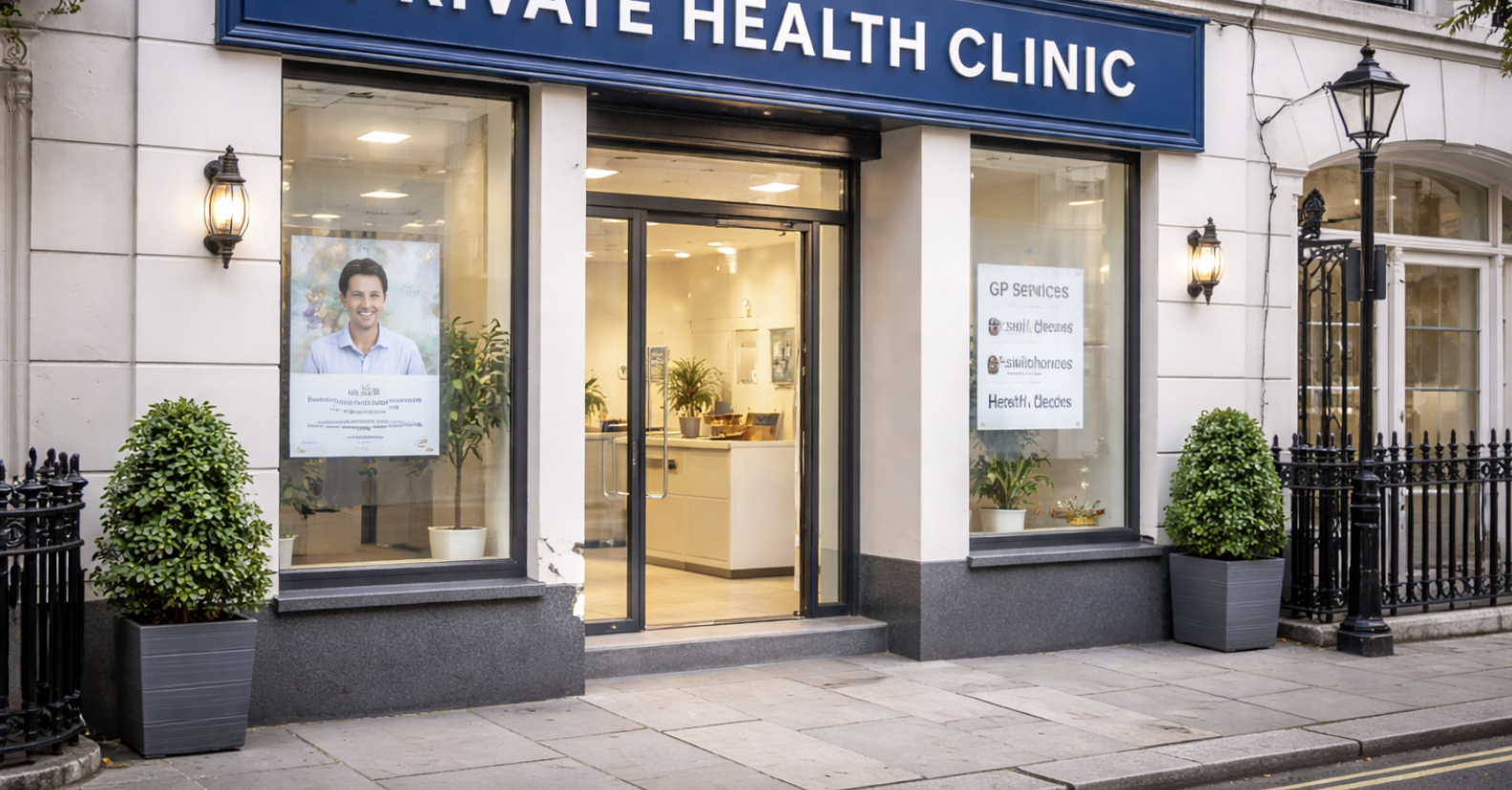
A strong landing page for a clinic should usually make the following clear very quickly:
- What the service is
- Who it is for
- Why someone should trust the clinic
- What happens next
- How to enquire or book
- Where the clinic is located
- Whether the service is private
- Any useful expectation-setting that helps filter poor-fit traffic
This does not mean every campaign needs a standalone landing page, but it does mean every paid click needs a tightly relevant destination.
Why healthcare experience matters in Google Ads management
Healthcare advertising is not just another vertical.
Patients search differently. Trust matters more. Ad policies can be more sensitive. Service language has to be handled carefully. And the commercial reality of a clinic is not the same as a standard e-commerce business.
That matters because Google Ads for private clinics is rarely just about turning campaigns on.
It is about understanding:
- Patient intent
- Private versus NHS confusion
- Service-specific search behaviour
- Compliance boundaries
- Commercial service prioritisation
- Operational realities inside the clinic
- The difference between a cheap lead and a valuable lead
A healthcare-focused approach usually leads to better strategic decisions because the account is being shaped around real clinic growth, not just ad platform activity.
Google Ads and SEO should support each other
Google Ads is powerful, but it should not always carry the whole burden alone.
The strongest clinic marketing strategies often combine paid and organic visibility. Ads can generate immediate demand and help test service appetite, while SEO builds longer-term presence and trust around those same services.
For a private clinic, this matters because paid ads can cover immediate opportunity while organic visibility strengthens over time. It also means search data from Google Ads can help inform SEO priorities, landing pages, and service positioning.
The end goal is not just more traffic. It is a stronger, more efficient patient acquisition system.
Signs your clinic’s Google Ads account needs attention
A private clinic account often needs restructuring when:
- Spending is rising, but enquiry quality is getting worse
- Calls are coming in from the wrong area
- Search terms look too broad or irrelevant
- Multiple services are blurred together
- Landing pages feel generic
- Nobody is clear which service lines are profitable
- The clinic is getting activity, but not the right kind of activity
- Reporting focuses on clicks, not qualified opportunities
These issues are common, but they are fixable.
The first step is not spending more. It is about getting clarity on what the account is actually doing and what kind of traffic is being bought.
What private clinics should expect from a Google Ads partner
If you are paying someone to manage Google Ads for your clinic, you should expect more than platform maintenance.
You should expect:
- Strategic service prioritisation
- Clear budget logic
- Thoughtful local targeting
- Control of search term waste
- Attention to lead quality
- Landing page guidance
- Commercially useful reporting
- Transparency about what is and is not working
That is exactly how Google Ads for private clinics should be managed: with a commercial focus, not fluff.
Book a consultation and let’s build a Google Ads strategy for your private clinic that delivers better leads, better control, and better use of your budget.
Why Spiders & Milk
Private clinics do not need a generic PPC package.
They need a Google Ads strategy built around patient intent, local demand, lead quality, and the realities of private healthcare marketing.
For private clinics, that means a more grounded approach to paid search:
- Tighter control of budget
- Better focus on high-intent traffic
- Stronger local targeting
- Improved lead quality
- Less wasted spend
- Clearer commercial direction

Ready to improve your Google Ads performance?
If your clinic is spending money on Google Ads but not seeing the quality of enquiries you need, the issue may not be the channel. It may be the structure, targeting, or control behind it.
We help private clinics run Google Ads in a way that is smarter, tighter, and more commercially useful. That means focusing on high-intent traffic, protecting budget, improving local precision, and reducing wasted spend so your advertising works harder for the business.
If you want more of the right enquiries rather than just more clicks, Spiders & Milk can help.