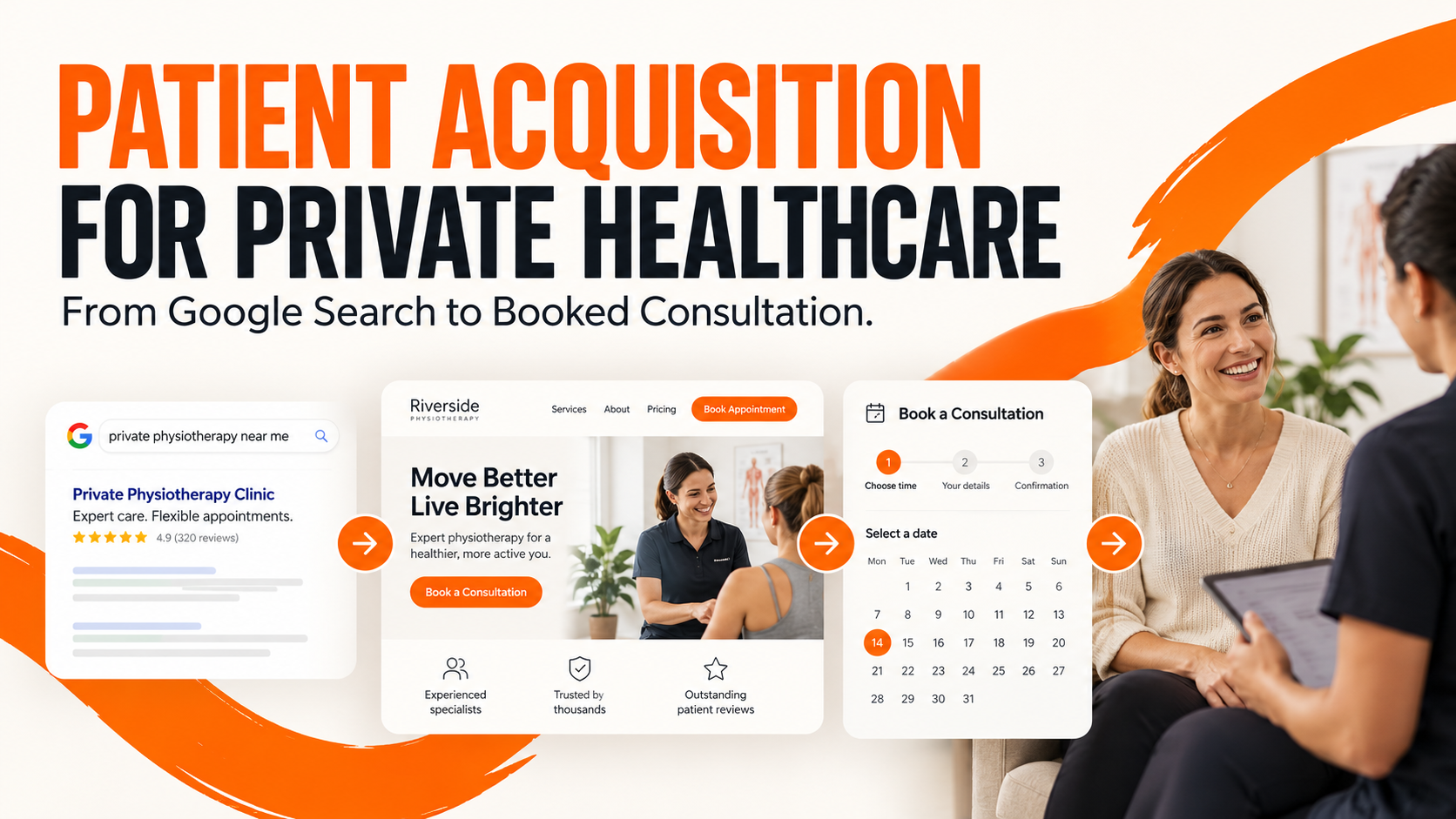
When someone searches Google for a private consultant, clinic, or healthcare service, they may already know what they need. Unlike marketing channels that introduce a service, Google Ads can put a private healthcare provider in front of people who are actively searching.
That makes Google Ads for private healthcare particularly useful for clinics looking to generate enquiries from patients with strong search intent.
However, successful healthcare PPC involves much more than bidding on a few treatment keywords. Campaign structure, search intent, location targeting, landing pages, advertising compliance and conversion tracking all influence whether paid search generates meaningful patient enquiries or simply consumes budget.
Clinic-specific campaign guidance: See our separate articles on private GP appointment advertising, consultant-led clinic Google Ads and private dental enquiry quality. The campaign, policies and booking routes differ by specialist practice.
Clinic marketing support: For paid-search management, eligibility reviews and better-qualified clinic enquiries, explore our Google Ads for Private Clinics service.
How Does Google Ads Work for Private Healthcare?
Google Search Ads allow healthcare providers to advertise against relevant searches made by potential patients.
A private clinic might build campaigns around searches relating to:
- A particular healthcare service
- A type of specialist or consultant
- A clinic or service in a specific location
- The cost or availability of private care
- A diagnostic service or consultation
- A specific treatment offered by the clinic
The objective is not simply to generate more website visits. It is to appear for searches that suggest the person may genuinely be considering private healthcare.
For example, someone conducting general research around a health topic may have very different intent from someone specifically searching for a private specialist in London.
Understanding that difference is fundamental to effective healthcare PPC advertising.
Start With Patient Search Intent
A strong Google Ads campaign should be structured around what potential patients are actually trying to achieve.
Service-Based Searches
People may search directly for a service, consultation or diagnostic procedure. These searches can be useful because the user already understands the type of healthcare they are looking for.
Specialist-Based Searches
Searches for a particular type of doctor, consultant or healthcare professional may indicate that someone has moved further into the decision-making process.
Examples might follow patterns such as:
private [specialist] London
[specialist] near me
private [speciality] clinic
Location-Based Searches
Location is especially important for clinics relying on patients within a realistic travelling distance.
A clinic in London does not necessarily benefit from paying for clicks from people searching hundreds of miles away. Geographic targeting should therefore reflect where patients are realistically likely to travel from, rather than simply targeting the whole UK by default.
Keyword Targeting Should Prioritise Relevance, Not Traffic
More clicks do not automatically mean more patients.
One of the biggest risks with Google Ads is targeting keywords that are too broad or loosely connected to what the clinic actually provides.
Campaigns should separate different services and patient intentions rather than putting unrelated keywords into one campaign.
This makes it easier to align the:
Search → Keyword → Advertisement → Landing page → Enquiry
Review the search terms report regularly. It reveals the actual searches that triggered ads and can identify irrelevant queries to exclude with negative keywords.
For private healthcare providers, these exclusions may help filter searches related to jobs, training, free services, research, or services the clinic does not provide.
Your Google Ads Should Match the Patient’s Search
The advertisement should make it immediately clear why the clinic is relevant.
Useful information may include the service available, clinic location, type of specialist and appropriate calls to action such as requesting an appointment or making an enquiry.
Claims should remain accurate and supportable.
UK healthcare advertising receives particular regulatory scrutiny. The CAP Code requires objective health claims to be supported by appropriate evidence, while Google’s healthcare advertising policies place additional restrictions on certain healthcare products, medicines and advertising activities.
Clinics should therefore review both Google’s current advertising policies and the relevant UK advertising requirements for the specific services being promoted.
Do Not Send Every Google Ad to Your Homepage
One of the most important parts of Google Ads for clinics happens after the click.
If someone searches for a specific private healthcare service but lands on a general homepage covering multiple specialities, they have to find the relevant information themselves.
A dedicated service or landing page usually provides a clearer journey.
The page should quickly answer questions such as:
- Is this the service I searched for?
- Where is the clinic?
- Who provides the service?
- What qualifications or credentials are relevant?
- What happens when I enquire?
- How can I contact the clinic?
- Is pricing information available where appropriate?
Google identifies ad relevance and landing-page experience as components it uses when assessing Search campaign quality.
This creates an important connection between Google Ads and healthcare website conversion optimisation. Paying for relevant traffic is only useful if the website gives those visitors a clear reason and route to take the next step.
Track Patient Enquiries, Not Just Clicks
Clicks and impressions can explain campaign activity, but they don’t tell a clinic whether Google Ads is generating valuable enquiries.
Measurement should be connected to meaningful actions such as:
- Appointment requests
- Enquiry form submissions
- Relevant phone calls
- Online bookings
- Other defined conversion actions
Call tracking can be particularly useful where prospective patients prefer speaking to the clinic before booking.
Where possible, clinics should also look beyond the initial enquiry. Understanding which campaigns produce suitable enquiries and eventual patients can provide a much stronger basis for marketing decisions than optimising purely for the cheapest lead.
Healthcare organisations must also consider privacy and consent when implementing advertising measurement. Google’s current consent guidance includes specific requirements affecting advertising data and measurement for users in the UK, depending on the technologies and features being used.
Healthcare Advertising Requires Additional Care
Healthcare should not be approached like ordinary ecommerce advertising.
Google categorises personal health information as a sensitive interest area for personalised advertising, which can restrict how health-related audiences are used for targeting and remarketing.
Some healthcare and medicines advertising is also subject to additional Google restrictions or certification requirements.
This makes campaign planning particularly important. Before launching, private healthcare providers should consider the service being advertised, targeting method, ad wording, landing-page claims and data being collected through tracking.
Compliance should be part of the campaign structure from the start, not something checked after ads are rejected.
Google Ads and SEO Should Work Together
Paid search and SEO for private healthcare clinics serve different purposes but can support the same patient journey.
Google Ads can provide immediate visibility for selected searches, while SEO builds sustainable organic visibility across service pages, locations, and educational content.
PPC data can also reveal useful information about the language prospective patients use and which landing pages generate enquiries. Organic search insights can, in turn, help identify services and topics worth testing through paid advertising.
The strongest digital marketing strategy therefore does not necessarily choose between SEO and PPC. It determines where each channel fits within patient acquisition.
Is Google Ads Worth It for Private Healthcare Clinics?
Google Ads can be valuable when identifiable search demand exists for the clinic’s services, and the campaign is built around genuine patient intent.
But don’t measure success by how many people click an ad.
A better question is whether the advertising is consistently connecting the clinic with relevant prospective patients at an acceptable acquisition cost.
That requires careful keyword selection, geographic targeting, compliant advertising, strong landing pages and reliable conversion measurement.
For private healthcare providers, effective Google Ads management is therefore not simply about buying visibility. It is about understanding what prospective patients are searching for, appearing at the right moment and creating a clear path from search to enquiry.
When those elements work together, paid search can become a measurable part of a broader private healthcare marketing strategy rather than simply another advertising expense.