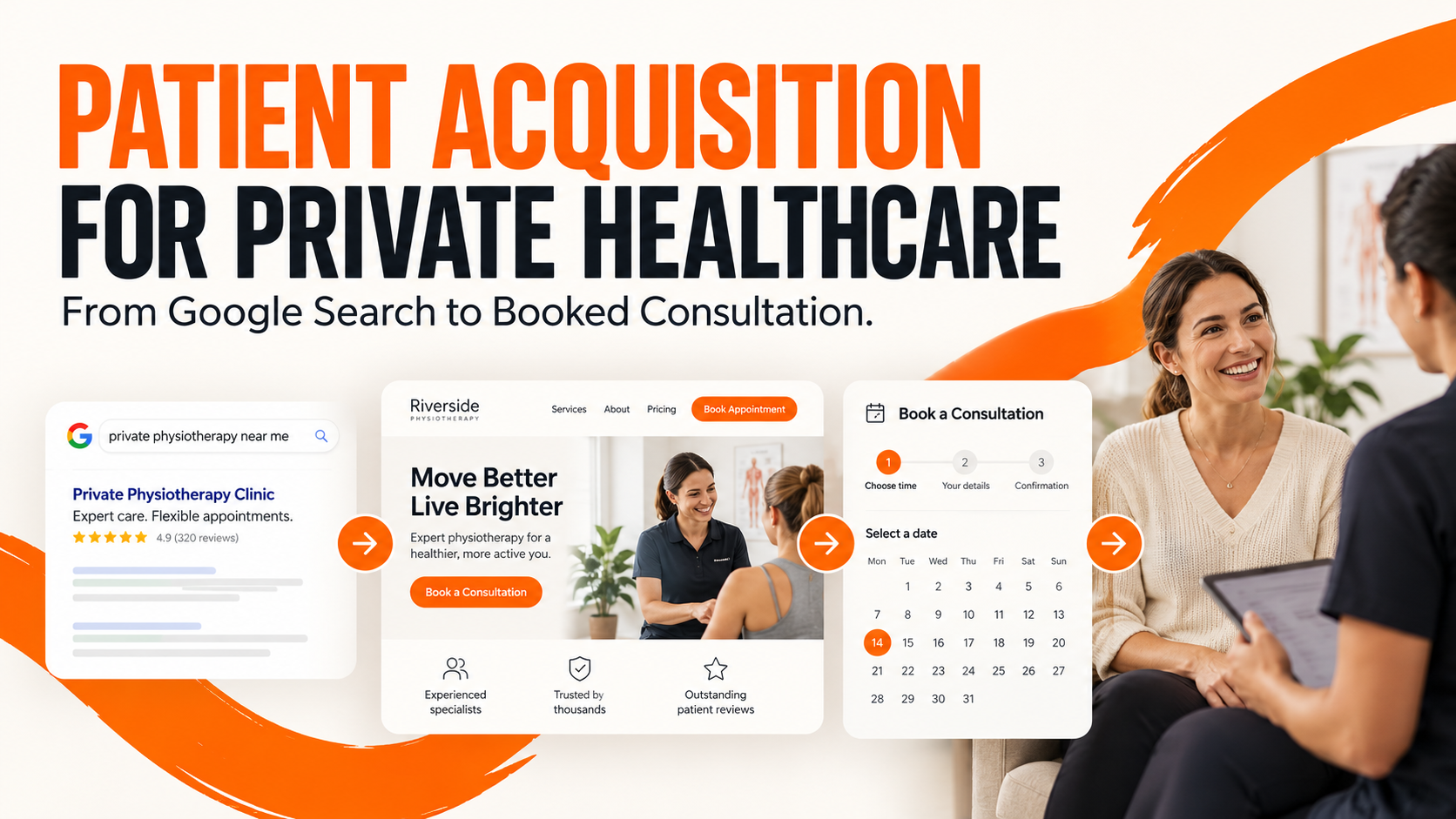
Private healthcare providers compete for attention in a search environment where patients can compare clinics, consultants, reviews and websites in minutes. For clinic owners and practice managers, digital marketing is no longer just about “being online”. It is about making sure the right patients can find you, understand what you offer and feel confident enough to enquire.
Effective digital marketing for a private healthcare practice relies on several areas working together, from SEO and local search to paid campaigns, website performance and online reputation. The real value comes from attracting the right people and giving them a clear, credible route from finding the clinic online to making an enquiry or booking an appointment.
Clinic marketing support: Clinic social media works best with factual practice updates and clear patient information; explore our Social Media for Clinics service.
What Is Digital Marketing for Private Healthcare?
Digital marketing for private healthcare uses online channels to promote a clinic, consultant or healthcare service to prospective patients. It can include healthcare SEO, local SEO, Google Business Profile optimisation, PPC, social media, content marketing, website optimisation and online reputation management.
Healthcare marketing differs from many other sectors because trust, accuracy and professional credibility matter throughout the patient journey. Marketing content must also be reviewed carefully to ensure that medical or treatment-related claims are appropriate and supported. The CAP Code applies specific rules to health-related marketing communications, including requirements for substantiating objective claims.
How Can Private Clinics Attract More Patients Online?
The strongest approach is usually to connect several channels rather than depend on one. A clinic may rank well organically but lose enquiries because its website is difficult to use. Another may run Google Ads but have weak local visibility or poor conversion tracking.
1. Improve Search Visibility with Healthcare SEO
Healthcare SEO improves the chances of your clinic being found by people looking online for the treatments, services or specialists you offer. For private healthcare providers, that usually means giving each key service its own well-developed page instead of placing everything under a broad, catch-all services section.
The wider site structure should also support those pages properly. Consultant or clinician profiles, relevant location pages, FAQs and useful educational articles can all help search engines understand the expertise and focus of the practice. Technical SEO matters too, particularly whether pages can be crawled and indexed correctly, how they link to one another, how well they perform on mobile devices and whether structured data is being used appropriately.
Google’s current guidance continues to prioritise helpful, reliable, people-first content and says the same core SEO principles apply to AI features such as AI Overviews and AI Mode.
For private clinics, this means healthcare SEO should focus on genuine expertise and useful information rather than producing large numbers of near-identical pages purely to target keywords.
2. Strengthen Local SEO and Google Business Profile
For clinics serving patients in a defined area, local SEO can be one of the most commercially important parts of a digital marketing strategy.
Your Google Business Profile should contain accurate contact details, opening hours, categories, services, photos and other relevant information. Google states that local results are mainly influenced by relevance, distance and prominence, while complete and accurate business information can help a business appear for relevant local searches.
This matters for searches such as “private dermatologist London”, “podiatrist near me” or “private GP Manchester”, where the person searching is looking for a provider in a particular area.
A dedicated local SEO service can therefore support both Google Maps visibility and wider organic search performance.
3. Turn Website Visitors into Enquiries
Traffic has limited commercial value if the website does not help people take the next step.
A private healthcare website should make it easy to understand what the clinic offers, who provides the service, where it is located, how to book and what to expect from the first appointment.
Clear calls to action, mobile-friendly pages, visible contact details and simple booking journeys can reduce unnecessary friction.
Healthcare website design should therefore be considered part of patient acquisition rather than simply a branding exercise. Every important service page should have a clear purpose and an obvious next step for someone considering an enquiry.
4. Reach Patients Searching with Google Ads
Google Ads can put a private clinic in front of people who are already looking for a particular service. This can be especially useful in competitive areas or for treatments and services the practice wants to grow.
A well-run healthcare PPC campaign needs more than a list of keywords. Targeted search terms should match genuine patient intent, adverts should follow relevant advertising rules, and each campaign should lead to a page that clearly reflects what the person searched for. Negative keywords and reliable conversion tracking also help reduce wasted spend and show which campaigns are generating enquiries.
The most useful campaign metrics are not impressions alone. Clinics should track actions such as calls, enquiry forms, online bookings and, where possible, qualified patient leads.
This makes it easier to judge campaigns by the opportunities they generate rather than simply by the amount of traffic they send to the website.
5. Build Authority with Useful Healthcare Content
Healthcare content marketing allows private providers to demonstrate expertise before a prospective patient makes contact.
The strongest content answers real questions in depth rather than publishing broad, generic topics simply because they contain relevant keywords.
For stronger E-E-A-T signals, clinics should make authorship clear, include relevant professional credentials, review important pages regularly and avoid unsupported claims.
Content should also connect logically to the clinic’s commercial services. An educational article can answer an initial question before directing the reader towards a related service, consultant profile or booking page when appropriate.
The aim should be to help the reader make an informed next step rather than pressure them into booking.
6. Manage Reviews and Online Reputation
Prospective patients may look at reviews, clinician profiles and third-party information before contacting a clinic.
Practices should have a consistent process for encouraging legitimate feedback, monitoring public reviews and responding professionally. Review management should always respect patient confidentiality and any applicable professional obligations.
Social media management can support the same trust-building process by giving clinics a platform to share useful information, introduce clinicians, highlight services and maintain an active professional presence.
How Should a Private Clinic Measure Digital Marketing?
A clinic should be able to see which marketing channels are generating meaningful enquiries.
Useful measures include organic search visibility, local search activity, paid conversions, website enquiry rates, telephone calls, online bookings and cost per qualified enquiry.
The key is to connect marketing activity with business outcomes.
Ranking for more keywords may be useful, but it is more valuable to know whether the website is attracting the right people and helping them become patients.
Marketing reporting should therefore move beyond traffic and impressions wherever possible and show how SEO, PPC, local search, content and the website contribute to patient acquisition.
Creating a Digital Marketing Strategy for a Private Healthcare Practice
Start with the patient journey, not individual marketing tactics.
Identify the services you want to grow, the locations you serve, the questions prospective patients ask and the searches that indicate genuine intent. Then make sure your website, SEO, local presence, paid campaigns and content support the same priorities.
For many clinics, the biggest opportunity comes from improving what already exists: clearer service pages, stronger local optimisation, better tracking, more useful content and a more direct route from search to enquiry.
Build Visibility Around Trust, Not Just Traffic
Digital marketing for private healthcare works best when visibility and credibility grow together.
Private clinics do not simply need more website visitors. They need relevant prospective patients to find accurate information, understand the service and feel confident taking the next step.
A joined-up strategy covering healthcare SEO, local search, PPC, content, website conversion, social media and reputation management can create a more effective approach to attracting patients online.
For clinics without the time, team or in-house expertise to manage digital marketing effectively, working with a specialist private healthcare marketing agency can make the process more focused and consistent. The right agency can bring together strategy, campaign delivery and performance tracking, helping the clinic understand what is working and where further growth opportunities exist.