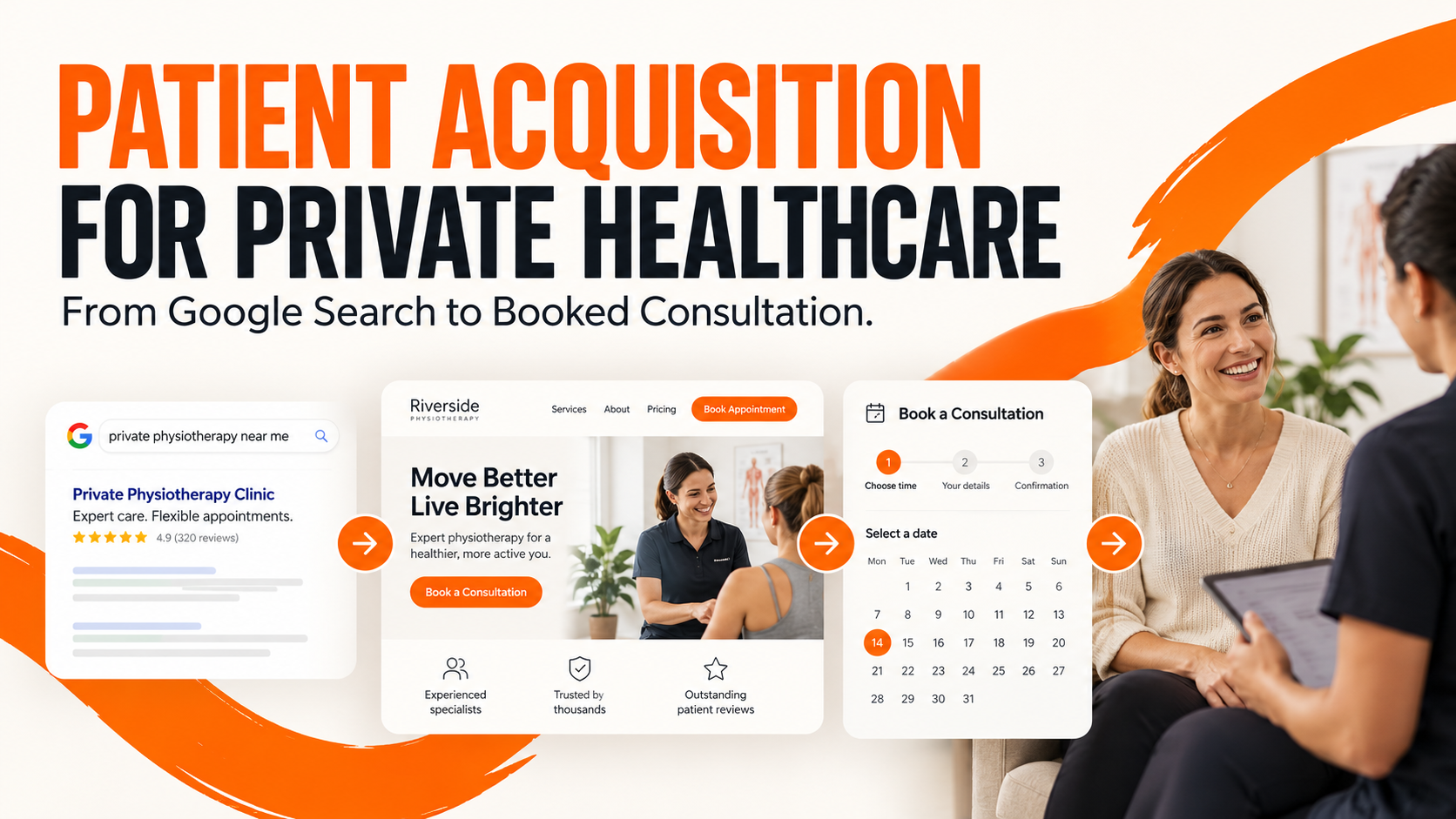
Successfully marketing a private clinic takes more than launching a website or paying for Google Ads. Before booking, patients want to understand your services, trust your clinicians and feel confident that contacting your clinic is the right next step.
This guide explains how to market a private clinic in the UK and turn greater visibility into measurable patient growth.
Clinic marketing support: For consistent public communication alongside SEO and advertising, see our Social Media for Clinics service.
Start with the patients and services you want to attract
Trying to promote every service to everyone usually creates unfocused marketing and wastes budget. Begin by deciding which treatments, consultations or diagnostic services are commercially important to the clinic.
For each priority service, consider who the appropriate patient is, what problem they need to solve, what language they might use when searching and how far they would realistically travel.
A private GP in Canary Wharf, for example, may need to reach residents and commuters. A consultant providing a highly specialist procedure may attract patients from across London or further afield. Geography, urgency, price and clinical specialism should shape the strategy.
Build a website around the patient journey.
A clinic website should do more than look professional. It must help patients decide.
Each important service needs a dedicated page explaining who it is for, what the appointment involves, who provides it and how to book. Relevant fees should be easy to find. Clinician profiles should include genuine qualifications, professional registrations and areas of expertise.
Navigation must also be simple, particularly on mobile devices. A patient should not have to search through several menus or read lengthy, unfocused text to locate a telephone number or booking button.
Useful clinic pages make the service, suitable patients, clinical team, location, fees and next booking step clear. Good design builds confidence; clear structure turns that confidence into action.
Use healthcare SEO to build long-term visibility.
Search engine optimisation helps a clinic appear when prospective patients are actively researching symptoms, treatments or local providers.
Effective healthcare SEO is not about repeating the same keyword. It requires technically sound pages, clear service information, relevant local signals and content that demonstrates genuine expertise.
One strong service page is rarely enough. Supporting articles should answer the questions patients ask before booking and connect logically to the relevant service. This structured body of content helps search engines understand the clinic’s areas of expertise, a principle commonly described as topical authority.
Healthcare content should be accurate, useful and appropriately reviewed. Named authors and reviewers, clinician biographies, publication dates and reliable references can all help patients understand why the information deserves their trust.
Strengthen local search visibility.
Many private healthcare searches have local intent. Patients may search for a service followed by a neighbourhood, city or phrase such as “near me”.
Your Google Business Profile, website and external listings should present consistent information about the clinic’s name, address, telephone number and opening hours. The profile should use suitable categories, provide current photographs and direct people to the most relevant booking page.
Location strategy should reflect real patient behaviour, not arbitrary city boundaries. In London and other major cities, travel time, transport connections, workplace location and local competition can matter more than straight-line distance.
Use Google Ads to capture immediate demand.
SEO takes time. Google Ads can place a clinic in front of people already searching for a relevant service, but poorly structured campaigns can spend money quickly without producing suitable patients.
Campaigns should separate services with different values, locations and patient intentions. Search terms need regular review to prevent ads appearing for irrelevant queries. Each advert should lead to a page that directly matches what the person searched for—not simply to the homepage.
Clicks and automated conversions are not enough to judge success. A reported lead could be an existing patient, a job applicant, a wrong number or somebody requesting a service the clinic does not provide. Check lead quality alongside cost.
Build trust before the patient contacts you.
Patients often compare several clinics before enquiring. Reviews are influential, but they are only one part of the trust picture. Detailed clinician profiles, qualifications, registrations, accreditations, authentic reviews, current photographs, clear fees and accurate contact information all provide evidence of credibility.
Sensitive or complex services require particularly careful communication. Marketing should remain factual, responsible and consistent with the professional and advertising requirements applicable to the clinic.
Make reception part of the marketing strategy.
Marketing has not completed its job when the telephone rings. Missed calls, slow replies or inconsistent information can lose patients who were ready to book. Reception teams need accurate service and pricing information, while call reviews can reveal recurring questions, training needs and points at which prospective patients disengage.
Measure patient enquiries, not vanity metrics.
Website traffic, impressions and keyword rankings provide useful context, but they are not the final measure of clinic growth.
Track telephone calls, forms and online bookings back to their source wherever possible. Then assess whether those enquiries were suitable and became appointments. Reporting should show which services and channels produce booked patients, acquisition cost, the pages that encourage contact and where prospective patients are lost.
Clinics should also retain appropriate access to their advertising, analytics, website and reporting accounts. Marketing data is a business asset and should support informed decisions.
Create a connected private clinic marketing strategy
The best results rarely come from one advert, one blog or one platform. A patient may first discover an article, return through a local search, read a clinician profile, check reviews and only then make a booking.
SEO, Google Ads, content, website design, reputation and enquiry handling should work as one system. When each element supports the next, marketing becomes easier to measure and better able to produce sustainable growth.
Spiders & Milk has specialised in healthcare marketing for nearly 20 years. We help private clinics develop clear strategies built around stronger visibility, better patient enquiries and meaningful reporting.
Need a clearer strategy for growing your clinic? Speak to Spiders & Milk.
Frequently asked questions
What is the best way to market a private clinic?
Most clinics benefit from a connected strategy that combines a conversion-focused website, local and organic SEO, targeted Google Ads, trust signals, and accurate enquiry tracking.
How Long Does SEO Take to Work for a Private Clinic?
There isn’t one fixed timescale. A well-established clinic website may begin seeing improvements fairly quickly, while a newer site competing for popular treatments in London or another major city will usually take longer. Much depends on the website’s strength, the local competition, and how much useful content already exists. SEO is rarely a quick fix; the best results come from improving the site consistently over time.
Should a Private Clinic Use Google Ads or SEO?
For most clinics, it shouldn’t be an either/or choice. Google Ads can put your services in front of patients who are searching now, while SEO builds visibility that can continue delivering enquiries over the longer term. Used together, they can support the same priority services: Google Ads provides immediate exposure while the clinic’s organic presence develops.