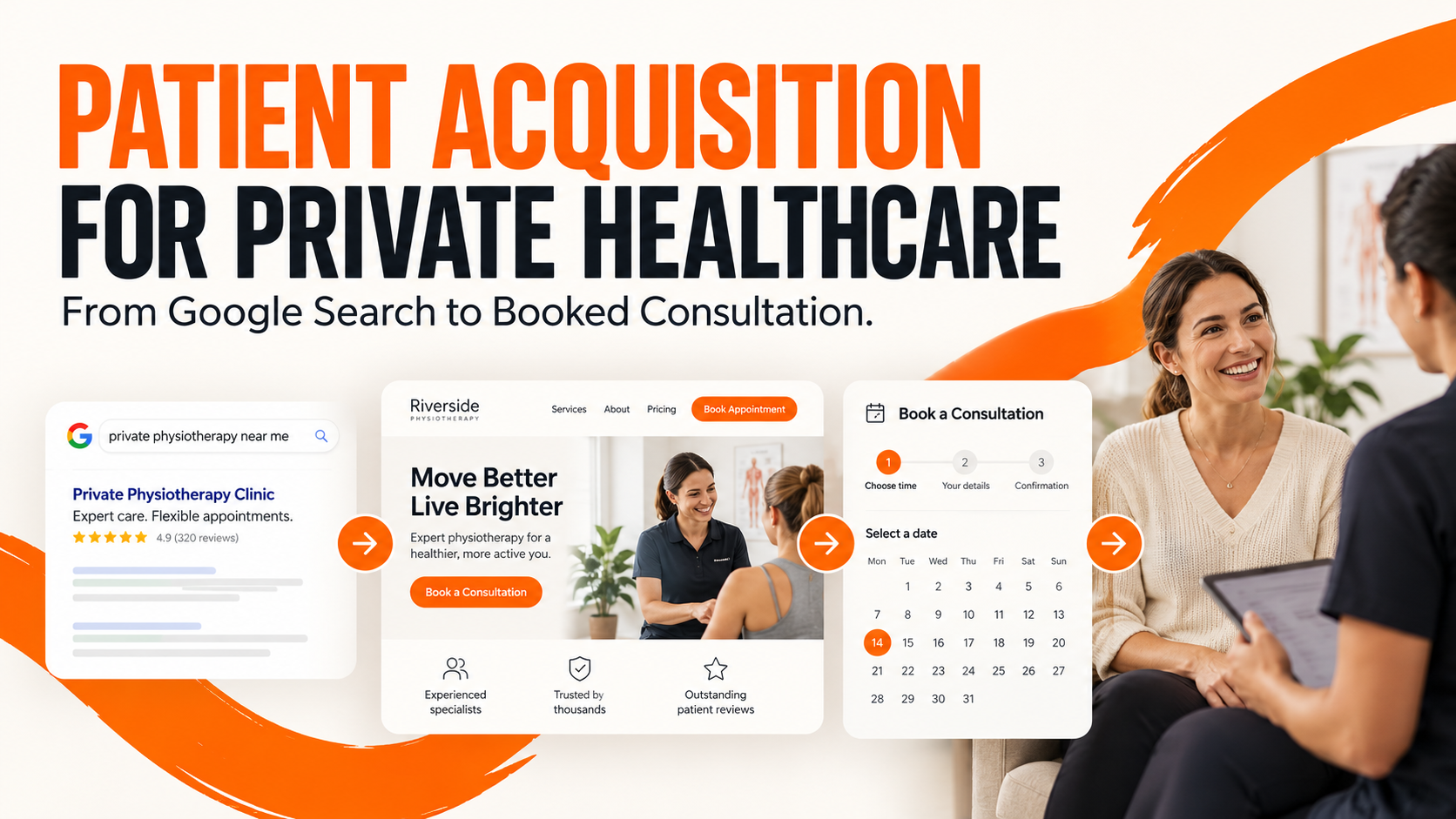
For a private healthcare clinic, local search visibility can directly affect how easily prospective patients find the practice.
Someone searching for a private GP, physiotherapist, consultant or specialist clinic will often want a provider in a particular location. They may compare opening hours, reviews, photos, services and website information before deciding which clinic to contact.
A well-managed Google Business Profile for private healthcare can help make that process easier.
Google Business Profile lets eligible businesses manage information shown to potential patients on Google Search and Google Maps, including contact details, opening hours, location information, photos, reviews, and website links.
For clinics, however, simply creating a profile is not enough. It should form part of a wider local SEO strategy that connects your Google presence with your website, location pages, reviews and patient enquiry journey.
For a practical location audit, see local SEO for private GP practices and dental practice local search and website checks. Each guide emphasises real clinic locations and accurate appointment information.
Clinic marketing support: Our healthcare SEO service includes Google Business Profile reviews, local search strategy and accurate clinic-location information.
Why Google Business Profile Matters for Private Healthcare
Choosing a private healthcare provider is often a local decision. Patients may already know what type of specialist or clinic they need, but they still have to work out which providers are conveniently located and suitable for them.
That can lead to searches such as:
- private GP near me
- physiotherapist in London
- private dermatologist Manchester
- podiatrist Canary Wharf
- private clinic near Liverpool Street
Google can respond to searches like these by showing nearby clinics and healthcare providers in its local search results and on Google Maps. This gives private healthcare businesses another opportunity to appear in front of people who are actively looking for a provider in their area.
Google states that local results are primarily determined by relevance, distance and prominence. Relevance considers how closely a profile matches the search, distance considers the relationship between the searcher and the business, and prominence considers how well known the business is, including information such as links and reviews.
Clinics cannot control every part of this equation. For example, you can’t change where a prospective patient is searching from.
What you can control is how clearly and accurately Google understands your clinic.
Start With Accurate Clinic Information
Your Business Profile should accurately reflect the healthcare business patients will encounter in the real world.
Check your:
- Business name
- Address
- Telephone number
- Website
- Opening hours
- Primary business category
- Additional categories
- Appointment or booking links
Google advises businesses to provide complete, accurate information and keep details up to date. Business names should also reflect the real-world name used on signage and branding rather than being altered simply to include additional search terms.
This is particularly important for clinics with several locations. Each legitimate clinic location should have accurate information that corresponds with the relevant location page on the website.
Choose Categories Based on What the Clinic Actually Is
Categories help Google understand the type of organisation represented by a Business Profile.
The primary category should describe the clinic as accurately as possible. You can then use additional categories where they genuinely represent other areas of the business.
Google specifically advises businesses to choose categories that describe what the business is, rather than using categories as additional keywords.
For private healthcare businesses, category selection therefore needs more thought than simply choosing every available healthcare-related category.
A multidisciplinary clinic, private GP practice, physiotherapy clinic and individual consultant may all require different profile structures.
Decide Whether Clinicians Need Separate Profiles
One area that can become complicated for healthcare businesses is the relationship between the clinic profile and individual practitioner profiles.
Google allows eligible individual practitioners, including doctors and dentists, to have dedicated profiles when they operate in a public-facing role and can be contacted directly at the verified location during their stated hours. Google also advises against creating multiple profiles for the same practitioner simply to represent different specialisms.
This means healthcare groups should consider profile architecture carefully.
Creating unnecessary or duplicate profiles does not create a stronger local search strategy. The objective should be to represent the real organisation, locations and practitioners accurately.
For a clinic with several sites and multiple clinicians, plan this alongside the website’s location and practitioner page structure.
Connect Your Google Business Profile to Strong Local Landing Pages
Don’t manage your Google Business Profile and website as two completely separate channels.
If a prospective patient clicks from a local listing for a specific clinic, the landing page should immediately confirm that they have reached the right place.
A strong clinic location page might include:
- The clinic name and address
- Telephone and enquiry options
- Opening hours
- Services available at that location
- Relevant clinicians
- Directions and transport information
- Accessibility information where appropriate
- Clear booking or enquiry calls to action
The objective is not to repeat the same location keyword throughout the page. It is to provide useful information that answers the questions someone considering that clinic is likely to have.
Make It Easy for Patients to Take the Next Step
Visibility has limited commercial value if patients cannot easily move from finding the clinic to contacting it.
Depending on the profile and business category, Google Business Profile can display website and appointment-related links. Google allows eligible businesses to add links that help customers take actions such as booking an appointment.
Think carefully about where those links send people.
Directing every visitor to the homepage is not always the most useful option. In many cases, linking to the relevant clinic location or service page gives the user a quicker route to the information they were looking for in the first place.
The same principle should apply across SEO, Google Ads and website conversion optimisation: the landing experience should continue the searcher’s journey rather than forcing them to start again.
Build a Sensible Healthcare Review Strategy
Reviews can help prospective patients understand others’ experiences with a clinic, and Google also states that review quantity and positive ratings can contribute to local prominence.
Clinics can therefore create a consistent process for requesting genuine reviews after an appropriate interaction.
Google provides review links and QR codes that businesses can share with customers. However, incentives such as discounts or free products or services in exchange for reviews are prohibited.
Healthcare providers should also take additional care when responding publicly. Replies should remain professional and should not reveal confidential information about an individual’s care or relationship with the clinic.
The aim is not simply to accumulate reviews. It is to create a genuine, appropriately managed picture of the patient experience.
Use Photos to Help Patients Understand the Clinic
Real, up-to-date imagery can make a Business Profile more useful.
Consider adding professional photographs of the exterior, reception area, facilities and clinical team where appropriate.
The objective is to give someone researching the clinic a clearer idea of where they are going and what the practice is like.
Avoid treating Google Business Profile as an image library updated once and then forgotten. Changes to premises, branding or facilities should eventually be reflected across the profile and website.
Measure Enquiries, Not Just Profile Visibility
A clinic’s objective is rarely to generate the highest possible number of Google Business Profile views.
It is usually to generate appropriate patient enquiries.
Google’s Business Profile performance reporting can provide information such as searches, profile views, website clicks, calls and requests for directions, with the metrics available depending on the individual profile.
Combine this with your wider analytics and enquiry tracking.
Useful questions include:
Which clinic locations generate enquiries?
Which search terms are leading people to individual profiles?
Are users clicking through to the website?
Are those website visits generating forms, calls or bookings?
Are particular locations attracting visibility without producing meaningful enquiries?
This turns Google Business Profile management from an administrative task into part of a measurable patient acquisition strategy.
Google Business Profile Should Be Part of a Wider Local SEO Strategy
Google Business Profile can be extremely useful for private clinics, but it should not operate in isolation.
Strong local visibility comes from making the entire digital presence understandable and useful: accurate profiles, relevant clinic pages, clear services, genuine reviews, strong website architecture and straightforward enquiry routes.
Google is explicit that there is no way to request or pay for better organic local rankings. Instead, its local systems evaluate factors including relevance, distance and prominence.
For private healthcare providers, the practical goal is therefore not to search for a shortcut.
It is to make sure that when someone searches for the type of healthcare provider you represent, in a location you genuinely serve, Google and the prospective patient can clearly understand who you are, where you are and what they should do next.
That is where Google Business Profile optimisation and local SEO for private healthcare can become a meaningful part of attracting more relevant enquiries online.